I, along with many others, find it impossible to be apathetic about sport.
It would seem suitably British to stoically pass off the failures of England at the World Cup (and the lack of any other qualifying home nations), or the whimper with which Andy Murray failed to defend his Wimbledon title today (and the whimper with which all of the other British entrants went out at the first hurdle). However, when the groans of centre court resound at another unforced error or Steven Gerrard meekly gives the ball away in midfield I can't help but feel gut-wrenchingly guilty on their behalf - as if I had committed the error myself.
It isn't with patriotism that I feel this way, in fact I recoil at our archaic national anthem ('God save the queen': a lyric that completely undermines any pride I had in our country to begin with, implying deference to a fictional deity and an impotent monarch). Instead I empathise with the individuals involved, because they are British and therefore in the grand scheme of things they have had relatively similar upbringings to my own. They haven't grown up in a favela or in the cataclysm of some natural disaster, rather they are the product of a great deal of money, time and effort. We have several affluent systems in place which are tasked with developing our youngsters into professional sportsmen, funded by the Premier League and the National Lottery. So, where are we going wrong?
It would be best to observe, I suppose, that we are a relatively small nation of people - despite our wealth - and that we don't have the pool of people to draw our talent from. This argument works at an Olympic level (where the achievement of countries tends to correlate with such things - and in fact we have done extremely well recently), but we have the most watched football league in the world, with clubs that have some of the richest history in world football, along with the most watched tennis tournament in the world (and tennis clubs and foundations that run alongside it). Our achievements in these sports pale in comparison to countries like Germany, Spain and Italy (and we can't rely on the old 'we have less people than them' argument either).
Greg Dyke is improvising a number of (to his detractors) ill-founded schemes to improve the talent available to the English national team (such as the introduction of premier league U21 teams to the football league), and there are many grassroots efforts to find the next British tennis talent. It seems as though we are trying to reverse the trend in both sports, but will it work? I find it hard to believe that we'll ever see a Brit with the natural flair and ability of a Lionel Messi or Roger Federer. That being said, 18 year old Scottish footballer Ryan Gauld has just signed with Sporting Lisbon - a Portuguese team renowned for their youth system - and has been touted as the 'Scottish Messi' (which seems like an oxymoron to me). Ross Barkley of Everton seems to have a portion of that flair in his game, yet also seems to be afflicted with the accursed modern English temperament (run around trying to do everything and fail to do anything). I say modern, because we did win something once, but unfortunately '1966'has become something of a stick to beat us with - with every world cup that passes we cling onto a victory 4 years further away.
Andy Murray had to leave the country to become the player he is today, spending his late teens in a Spanish tennis academy. Therefore, ironically (or perhaps conveniently) he cannot be considered a product of our many sporting schemes. Therein lies the problem, in my opinion, that the games of tennis and national football require a mental resilience and arrogance that cannot be acquired from a childhood in Britain. Perhaps our lives are too comfortable, or the distractions too abundant, but there does appear to be something in the water - so to speak. I hope I'm wrong, for sport is best enjoyed when there is a side to support; and one hopes that the pain endured will make future victories all the more sweet.
Speculum
EVERYTHING through the eyes of Edward White http://goo.gl/cwECyT
Wednesday, 2 July 2014
Monday, 17 March 2014
Reverend & The Makers: 'Poshification' of Pop Music
I recently had the opportunity to interview the ‘Reverend’
Jon McClure, eponymous front-man of ‘Reverend & The Makers’.
Slightly nauseous with the usual pre-interview jitters, myself and a colleague were gratefully presented to our willing subject in the shabby dressing room of Liverpool’s O2 Academy. It was four in the afternoon but McClure proffered us a beer, which we gladly accepted. He sat down to roll a joint as we took in our surroundings and went over the questions we had prepared. It was not my first interview by any means, but it was certainly the first that had any semblance of an authentic rock’n’roll experience. I had seen the insides of tour vans and dressing rooms before but there was something electric in the air around ‘Rev’’ and his entourage of band members (including wife, keyboardist and tour manager, Laura McClure) which nullified the stagnancy of sleep deprivation and hangovers that accompanies a busy touring schedule. The fridge was stacked with booze and some bright-eyed mod-coiffed members of a young supporting band were hovering around, along with ‘The Subways’ bassist Charlotte Cooper (married to drummer Ryan Jenkinson).
We had expected the standard exercise in P.R. that
accompanies an album tour: a glib 5-minute assessment of the album’s critical and
commercial reception, then some brief discussion of the band’s history (in this
case, a particularly interesting relationship with the genesis of the Arctic
Monkeys). We were naïve, however, and should certainly have expected more from the
‘reverend’, whose justification for such an audacious self-assigned nickname
is that he’s “a
big mouth and always running on at people”.
That description doesn't quite do the man justice. Jon McClure’s mouth is a black hole from which
all hell breaks loose, a cosmic singularity of brutally insightful opinions, contrived
with a brand of romantic whimsy and poetry that has become sadly alienated from
the new generation of indie musicians.
I invite you to listen
to the interview in its entirety, but I must admit that at 35 minutes long (the
shortest cut I could make) it could do with a summary. One particular
observation struck me the most, reflecting an idea in my own head which I had
cultivated but couldn’t put into words or colour with any specific facts or
statistics. McClure claims that chart music has become dominated by the upper
classes, with far more modern acts coming from British private schools than 20
years ago. He argues that this is both responsible for, and at least partially caused by, a culture of alienation regarding pop music, with large sections of society
having their tastes ignored by the mainstream media. Acts like Oasis, The Stone
Roses and The Beatles were working class and talked about it, but they might
never have reached the heights of their success if they were going today. He
complains about the way in which Radio 1 tried to lower its age demographic by
introducing more youthful and commercial music, but succeeded only in providing
that music with an exclusive outlet to the same demographic they began with.
Is he right? If you
compare today’s top 40 with the top 40 of this week 20 years ago, at my
estimate 6 of today’s top 40 singles are attributed to artists who attended
state school in Britain, compared to 8 that are attributed to artists who
attended private schools. The remaining 26 singles are attributed to foreign
artists (the bulk of which are American). For this week in 1994, 13 of the
songs in the top 40 are attributed to artists who attended state school in
Britain, with another 8 British artists whose education can’t be reliably
assessed. None of the British acts in the top 40 can be reliably determined as
private schooled. This approach is time-consuming and even with more analysis
couldn’t really be used as reliable data for determining whether McClure is
right in his assessment, but it seems to give a pretty clear picture that the
background of pop musicians has changed significantly over the past 20 years.
Why might this be? One
answer is that the opportunity to become an artist in today’s popular medium -
electronic music - requires access to expensive professional producing
equipment and software. McClure also makes the point that bands who come from
affluent backgrounds can afford to tour, making the amusing point that he
couldn’t achieve the success that (privately educated) Mumford & Sons have
enjoyed in America because if he committed the time and money required to crack
a new country then his ‘gas bill won’t get paid.’
Mumford & Sons: Nice Middle-Class Boys in Waistcoats
You might respond with
the idea that if a band is good enough, or if they achieve a sufficient degree
of commercial success, then the content of their songs or the background of the
members wouldn't matter to the mainstream media. After all, commercial music is
all about sales isn't it? You’d be wrong, and this is where the injustice
becomes personal for McClure, his band’s past two albums both reached the album
chart top 20 (with their latest album ‘Thirty Two’ reaching no.9) yet received
no airplay from any of the major radio stations. You may dislike the music that
they make, but shouldn't the popularity of Reverend & The Makers justify
their music being on the radio? McClure feels that the hard-core group of fans
who pack out their gigs up and down the country (to which I can testify, having
observed first-hand the teeming crowds which flocked to the O2) are ignored and alienated by a mainstream culture that no longer reflects British
culture, instead attempting to dictate it. When a public service broadcaster
like the BBC fails in its duty to reflect the public’s taste you can’t help but
sympathise with those, like Jon McClure, who see it as a class bias.
The Reverend might be
brash with his opinions to some, but I don’t think anyone could categorically
state that he’s wrong. His point isn’t to
prove there is something wrong with the music created by privately-schooled artists;
rather, he wants to show that the market has become saturated with a brand of music
typically created by these artists. A particular type of music, working-class
music, has become unfashionable to the powers that preside over mainstream
radio and major labels. The environment for artists creating such music has
become much less hospitable and I, for one, am worried that we might be smothering
the next generation of British bands without even realising it.
Monday, 24 February 2014
Russia's P.R. Nightmare
Apparently 'not' the ascension of the devil himself, nor an evil necromancer with the ability to raise armies from the dead.
But I didn't make the first bit up, Putin & the establishment
of Russia genuinely want to shield children from the ‘propaganda’ of homosexuality.
To claim that this doesn't constitute institutional homophobia is bizarre, for
it implies that the sexuality of these children is open to some manipulation,
or that homosexual people have a tendency to enjoy interfering with children in
some way. It all seems hinged upon an association of homosexuality with illegal
sexual perversions, or an assumption that homosexuality involves a choice –
both of which are ideas that are demonstrably false, and are also views typically held by homophobic people.
In fact, it has been noted that “many child molesters cannot be meaningfully described as homosexuals, heterosexuals, or bisexuals (in the usual sense of those terms) because they are not really capable of a relationship with an adult man or woman.” Not only that, in the majority of test cases the number of 'regressed' heterosexual men abusing children was greater than the number of 'regressed' homosexual men. Just wait until Putin hears wind of this and starts a hate-campaign against opposite-sex relationships. "We must prevent all this toxic heterosexual propaganda from reaching our delicate children's ears!"
It has also been shown that homosexuality can run in families, particularly along the maternal line, and research is being done to identify genetic information that could reveal something about the mystery of sexuality. In my opinion, all one needs to do to address the ‘nature or nurture’ debate over homosexuality is ask those who are homosexual what they consider the factor to be, and overwhelmingly one will receive the response that it is something they have felt from a very young age which feels essential to them as a person, not something they have appropriated as behaviour. It is my belief, along with many others, that a child who grows up in an exclusively heterosexual environment may turn out to be gay, bisexual or transgender.
In fact, it has been noted that “many child molesters cannot be meaningfully described as homosexuals, heterosexuals, or bisexuals (in the usual sense of those terms) because they are not really capable of a relationship with an adult man or woman.” Not only that, in the majority of test cases the number of 'regressed' heterosexual men abusing children was greater than the number of 'regressed' homosexual men. Just wait until Putin hears wind of this and starts a hate-campaign against opposite-sex relationships. "We must prevent all this toxic heterosexual propaganda from reaching our delicate children's ears!"
It has also been shown that homosexuality can run in families, particularly along the maternal line, and research is being done to identify genetic information that could reveal something about the mystery of sexuality. In my opinion, all one needs to do to address the ‘nature or nurture’ debate over homosexuality is ask those who are homosexual what they consider the factor to be, and overwhelmingly one will receive the response that it is something they have felt from a very young age which feels essential to them as a person, not something they have appropriated as behaviour. It is my belief, along with many others, that a child who grows up in an exclusively heterosexual environment may turn out to be gay, bisexual or transgender.
So, while one can
easily make jokes about two-man luges and caricature the country that facilitates
such vile infringements of justice, it might be better to properly discuss how a
country, with its multitudes of people, opinions and leaders can be diverted from
a path we so clearly see as wrong.
Monday, 1 April 2013
Hot Air: Loud Trump Politely Ignored By Scots
Scotland has approved the construction of a wind-farm situated off the coast of Aberdeen, much to the dismay of leather-faced shit-magnate Donald 'Grizzly-Tits' Trump.
The custard-maned billionaire criticised the construction as a 'purely political decision'.
Trump - who owns a £750m golf resort/trouser exhibition that overlooks the north sea several miles away from the proposed site - has threatened to use his raging financial lovemuscle to nip the project in its tender virginal bud. The basis of his complaint being that those distant pylons will spoil the view from his luxury course, itself controversially built on protected Scottish dunes. Hypocrisy, thy name is Donald.
The custard-maned billionaire criticised the construction as a "purely political decision." As opposed to a culinary decision, like "what am I going to have for tea tonight?" or "do I prefer my nipples smothered in peanut butter, or whipped cream?" Which are far more relevant decisions to ol' murder-eyes-Donny.
What Trump means to say is that no factors apart from political popularity-mongering have been considered, which is highly ironic considering how unpopular the decision appears to be. Also ironic, yet satisfyingly typical, is the fixation behind Trump's own opposition to the scheme: He thinks it might lose him a bit of money.
You see, the clients of his golf course are millionaires, and millionaires don't like to be confronted with the realities of cheap, renewable energy. It makes them worry about terrifying things like healthy poor people, wealth redistribution and affordable luxuries. Donald never wants to have that nightmare ever again, you know, the one where he wakes up in the middle of the night screaming "NO FIDEL, NOT THE HUMMER, TAKE ANYTHING BUT THE HUMMER!!!" before realising it was all some quasi-socialist dystopic dream, coddling up to his US constitution-inscribed body pillow and wanking over the dots and zeroes in his bank balance. If you squint they look a bit like boobs, hurr hurr.
It appears that all this worrying and furious masturbation has put a dent in plans for a second 18-hole course. Poor little Donald Duck-face can't believe that something as irrelevant to his short-term future as a government sponsored £230m renewable energy project might get in the way of these plans. Oh, and it's ruining the Scottish countryside or something...
Interestingly, the proposed windfarm in question would be used as a test-bed for advanced turbine designs, thereby contributing to global research into how we are going to survive on this planet after Trump's all-encompassing ego is gone, no longer blocking the thick smog from reaching the ozone layer. To criticise the project for disregarding natural beauty is tantamount to criticising flu vaccinations for giving you the sniffles. Those glorious highlands and his tosser-filled golf course won't look so pretty when the icecaps melt and they're 200ft underwater.
In the end it appears that Trump's enormous wealth won't buy him the same political sway he enjoys across the pond. His 'good friend' Alex Salmond - the Scottish first minister, a teddy-bear clone of Gordon Brown with the ability to smile and not look like a wincing turnip - has ignored persistent tantrums and pressed ahead. Donald will just have to hope that when he does finally suffer through the indignity of phallic turbines penetrating his precious Scottish vista, he'll remember to clear out all the muck from his sand pit.
Labels:
aberdeen,
alex salmond,
donald,
farms,
golf course,
government,
scotland,
trump,
turbines,
wind
Thursday, 28 March 2013
Armenia's Compulsory Chess Curriculum (and how it might change the world.)
In an attempt to make the world a brighter place, Armenia has added compulsory chess lessons to its curriculum for pupils as young as seven.

Beyblades and Pokemon cards just won't cut the mustard for adolescent strategic training these days.
Armenia - as a former soviet state and a place of eccentric cultural heritage - is as obsessed as any other developing country with improving the quality of its education. Over the past 7 years, Armenia has won the comically pretentious 'chess olympics' three times. The country's leading chess player Levon Aronian is a national hero; Bestowed the title 'Honoured Master of Sport of the Republic of Armenia' by the government, he is essentially the Armenian David Beckham, minus the angelic face and athlete's physique - yet crucially in possession of a fully-functioning brain. I suppose he's a bit more like Sebastian Coe, you might say...if you were Sebastian Coe. The blubbery narcissistic windbag.
As any civilised member of society knows, the natural progression from domination in any sport is a dogmatic shoving-it-down-the-throats-of-anyone-and-everyone. The Armenian leadership has even gone so far as legislation to such an effect, by forcing their premature kinderwinks to play the family-friendly war simulator. Beyblades and Pokemon cards just won't cut the mustard for adolescent strategic training these days, chess providing you with strategic know-how, competitivity and hours of fun. Right...
The games of chess I experienced at a young age were about as tactically coherent as the Pyongyang guide to military strategy and about the same level of fun as turning on a tap. The only thing I found more boring at the time was the activity that led me to consider playing chess, such was the drudgery involved. All this aside, perhaps if I were given some actual insight into how to play the game - and a suitable reward for winning - I would have found some enjoyment in it, maybe even suffered some irreparable brain development. Gee-whiz!
But hold on a minute! Chess teaches children the raw basics of aggressive military combat. Flank your opponents, attack their most vulnerable resources and if all else fails, shatter the foundations of their society with religious extremism. Those forwardly challenged bishops, a covert metaphor for the subversive nature of religion. This is what we should be teaching our children? That we should ruthlessly strike at those who are our equals, but for the colour of their skin? What exactly is Armenia's plan? To condition a super-race of ruthless, xenophobic tactical experts? The Hitler youth had it all wrong! Start them off earlier and subconsciously impregnate them with your sadistic views through the most socially acceptable of violent war-games. In twenty years time we'll all be hailing Aronian as our 'Supreme Master of Racial Cleansing' as we goose-step through the black-and-white marble streets, homage to the game that started it all.
Or perhaps not. Perhaps it will merely plant a seed of intellectual strategy, one that will blossom into a nation of sharp-minded, forward-thinking individuals. Or perhaps, as is most likely, it will be quickly forgotten about and have zero impact on their meagre lives, as they toil through the economic wasteland we are so happily laying out for them. Either way, it might be worth a go Cyprus, you've got very little to lose.
Follow Edward on twitter: http://www.twitter.com/edwinawoowoo
Saturday, 23 February 2013
Black Mirror - 'White Bear' : Review
The second installment of Black Mirror’s eagerly anticipated follow-up series is a confusing, sprawling and horrific thriller. Desperately bleak in contrast to the episode that preceded it, ‘White Bear’ takes inspiration from zombie horror and spins an imaginative satire of communication technology and capital punishment.
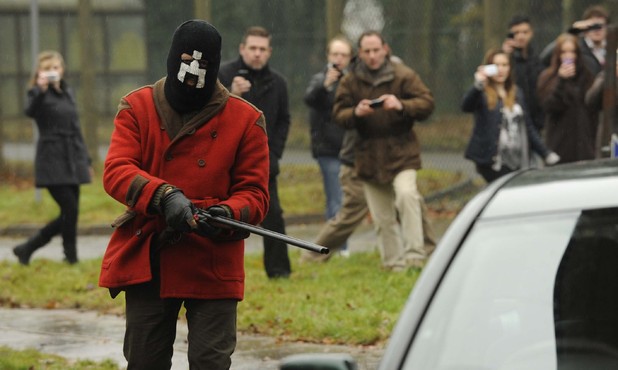
We follow a young woman, waking up in a strange bedroom with a splitting headache and no recollection of how she got there. Fun as that may sound, our ‘protagonist’ apprehensively meanders around the house desperately looking for clues as to her whereabouts. As she leaves the house and wanders the encompassing estate, her movements are stalked by unresponsive voyeurs armed to the teeth with iphones. This serves as a blunt comment on the social media apparatus that have provided yet more barriers between us and the real world. These iphone zombies are herded by a set of masked hunters with video-game comical weaponry, from a hunting rifle to a baseball bat (typical Brooker), who have taken it upon themselves to hunt down those that are immune to the pseudo-zombification that has befallen the rest of mankind.
The episode goes on to play out as any other horror flick would do, the woman and her accomplices getting into some jeopardy with their hunters and striving to knock out the zombifying radio signal that is responsible for all the stalking masses. It feels like a B-Movie, and so it should given the context. Unremarkable dialogue, with strange pacing and some odd camerawork, make the first half an hour slow watching, as though it were building to a crescendo. And crescendo it does, with a twist as unexpected as Bruce Willis being dead on The One Show.
It turns out that the leading lady is being punished for a Myra Hindley-esque role in the murder of a young child, of which brief glimpses had been seen in flashbacks throughout the episode. The entire plot up until this point has been an elaborate fiction, her accomplices and tormentors just actors. Inside the radio tower, the blinking lights of electrical equipment rotate and reveal an audience of people recording her confusion on their iphones. As she is strapped to a chair, the woman is told of her crime by an irish justicar and led through a cackling canyon of incensed citizens, the very zombies who had pervaded her fictitious adventure. The mob want to punish the ‘murderer’, whose crime was to film her boyfriend as he torched the young girl to death. It makes for extremely uncomfortable watching.
So, it turns out the entire episode had taken place in a sort of ‘punishment theme park’, where people can pay to interact with the groundhog-day justice system. An endless loop of allegorical torture is painted as a fate worse than death, and one would be inclined to agree. I certainly found it sickening, but couldn’t be certain that it was Brooker’s intention. I don’t think he intended any message convincingly either way, rather I would imagine his only intention was to paint an absurd parody of what capital punishment could become. He succeeds, and despite its flaws this series stands as some of the most imaginative and enthralling television I have ever seen. Long may it continue.
Wednesday, 20 February 2013
Review: Black Mirror - 'Be Right Back'
The first installment of this subsequent series epitomises the artistic depth that such a method can achieve. Charlie Brooker’s dialogue in this episode has surprised many critics through its sheer innocence and believability, his characters - a young couple deeply in love - converse in a natural and endearing manner. So subtle is the dialogue, that only on second watching are the foreboding hints noticed: Martha questions Ash as he ignores her while poring over his mobile phone, ‘Are you still solid?’.
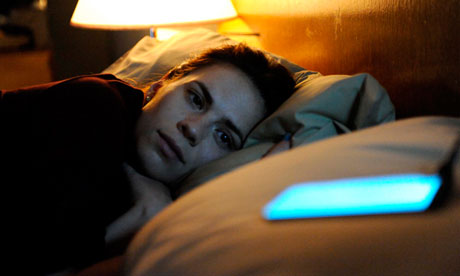
Quite predictably, Ash is killed off within the first 15 minutes. Martha’s apprehensive wait when he does not return home, and the consequent blue lights that appear on the driveway, are typical of every spouse’s worst paranoia. Ash returns, however, through an app that allows a deceased user’s voice and mannerisms to be amalgamated into an automaton that lives inside Martha’s phone. This leads to an unsettling relationship between Martha and her phone, culminating in Martha’s hysterics after she accidentally breaks her phone on the floor. The acting is fantastic, the emotions tender and universal, the trauma crisp and captivating.
Brooker does not stop there. Ash explains that there is ‘another level’ to the artificial resurrection. The body comes shipped in a cellophane bag, and must be left to stew in the bathtub before activation. When Ash is restored, just a computer program inside a robotic body, the confusion and revulsion are profound. Martha is so pleased to have Ash back, yet slowly discovers that there is something more to a human being which the computer program cannot capture, an autonomy and spontaneity that makes human relationships worthwhile.
In this moral we find the underlying motivation for the series itself. Something can be so convincing, yet with one slight defect or mutation can be considered abhorrent. There is something human to society that Black Mirror perverts, much like Ash’s digital persona does not quite appease Martha’s grief. However, the difference is that this sinister effect is the purpose of Black Mirror’s exercise. The revulsion we experience can enable us to question how we might act in a similarly tragic scenario. Not only that, it reveals something about the subtleties of human nature which melodrama ignores, which in this instance is the necessity of grief when mourning someone you love, and the strength that confronting loss can provide. Fascinating and cathartic, brilliant television.
Subscribe to:
Posts (Atom)